I spent $250,000 learning what a $1,000 plan would have told me
My first pool was a $250,000 disaster dressed up in travertine and LED lighting. The builder said $180,000. I signed. Then the change orders started. Equipment upgrades the builder called "mandatory." A retaining wall nobody mentioned during the design phase. Grading work that "wasn't in scope." Every two weeks, another $8,000 to $12,000 addition that felt non-negotiable because the hole was already in the ground.
Final cost: $247,000. I didn't complain. I didn't know enough to complain.
Second pool, different house. Smarter this time — or so I thought. I negotiated harder, picked a more reputable builder, got a tighter contract. Still ended up with a $14,000 change order that should have been $0. The builder "discovered" rock during excavation that any geotechnical survey would have flagged. I paid because the alternative was a half-dug hole in my backyard.
Third pool. Completely different approach. I hired a transparent builder, brought in an independent advisory perspective, and built a clear-eyed budget from day one — every line item, every contingency, every potential surprise mapped out before the first shovel hit dirt. Cost less than pool number one. Delivered more. Not a single surprise.
I didn't need to spend less. I needed to spend right.
That experience — three pools, over $600,000 in construction costs alone, plus landscaping, decking, and equipment on each — is why AquaSteer exists. And it is why I am writing this article. Because the difference between a backyard that drains your savings and one that delivers exactly what you envisioned is not how much you spend. It is how you spend it.
The honest budget spectrum: $5,000 to $100,000+
Every backyard project falls into one of four tiers. The dollar ranges below reflect 2025-2026 national averages. Your market may be 15% to 30% higher (coastal California, South Florida, metro NYC) or 10% to 20% lower (Midwest, rural Southeast). The principles hold regardless of geography.
$5,000: The refresh
This is not a renovation. This is a reset. New outdoor furniture, landscape cleanup, fresh mulch, a coat of paint on the fence, and upgraded lighting. According to the National Association of Landscape Professionals, the average American household spends $3,600 per year on lawn and landscape services — so $5,000 buys roughly 16 months of professional landscape care, or one focused weekend blitz with quality materials.
What $5,000 buys:
- Landscape refresh: dead plant removal, 3 to 5 new shrubs, fresh mulch, container gardens and planters ($1,000 to $1,600)
- 12-volt LED landscape lighting kit: 8 to 12 fixtures, transformer, wire ($400 to $800 DIY installed)
- Outdoor furniture set: dining table with 4 to 6 chairs or a quality sectional ($1,500 to $2,500)
The $5,000 refresh is entirely DIY-safe. No permits. No contractors. No structural risk. Start here — especially if you have lived in the house less than two years and are still learning how you actually use the space.
$15,000: The upgrade
Now you are adding built elements — patio extension, basic outdoor kitchen, landscape designer planting plan — and you need at least one contractor, typically a hardscaper or mason.
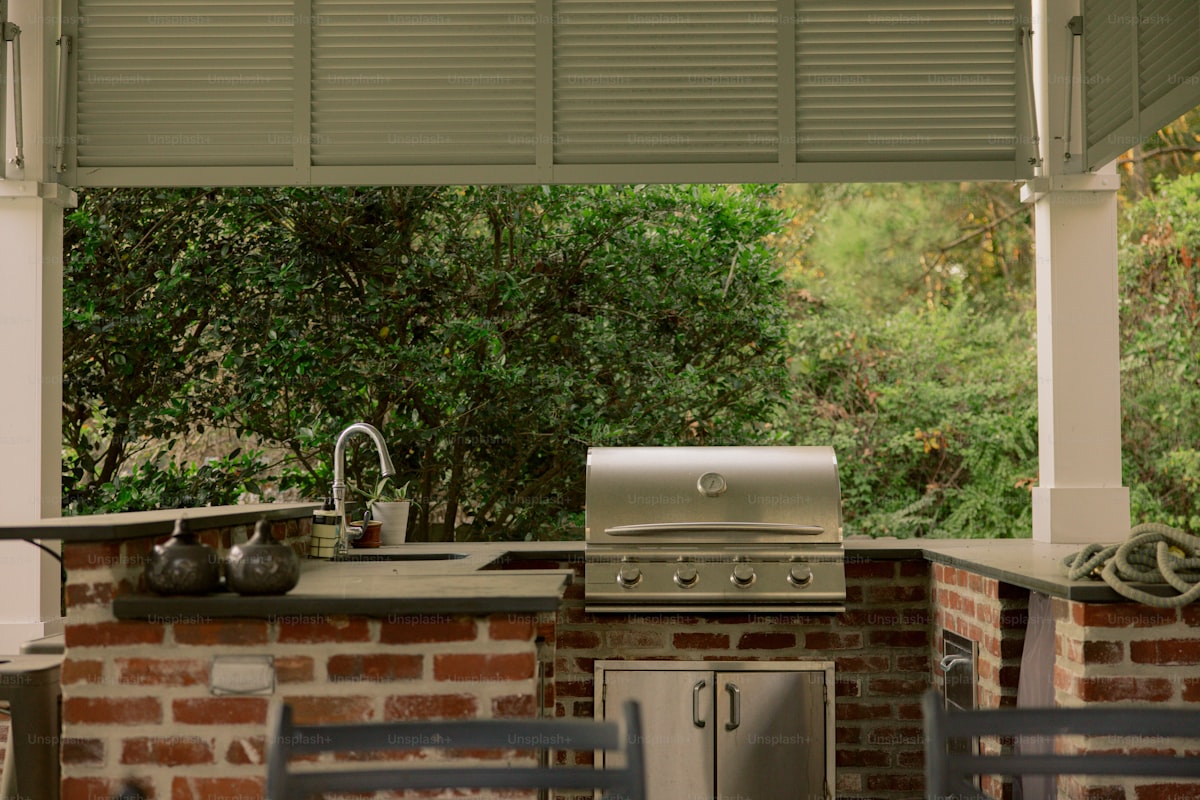
Per HomeAdvisor's 2025 cost data, average patio installation runs $3,400 to $6,800 for 200 to 400 square feet of concrete pavers. Add a grill island ($3,000 to $6,000 including gas line) and landscape planting ($2,000 to $4,000), and you are squarely in the $15,000 range.
Critical decision at this tier: get a $300 to $500 site survey before you build anything. It flags drainage issues, utility easements, and setback requirements that force expensive redesigns later. Skip it and you are gambling. For material costs and layout strategies, see our patio design guide.
$50,000: The renovation
At $50,000 you are replacing or adding significant hardscape — full patio redesign, built-in outdoor kitchen, fire feature, or a plunge pool. Multiple trades involved: mason, electrician, plumber, possibly a pool contractor.
NAHB construction cost data confirms what I see in every project review: residential outdoor projects between $40,000 and $75,000 routinely run 20% to 25% over the original contract. On a $50,000 project, that means finishing at $60,000 to $62,500. That gap is not bad luck. It is predictable. And it is preventable with a complete design plan and independent bid review before construction starts.
Plunge pools (10 to 15 feet, 4 to 5 feet deep) run $25,000 to $45,000 for the pool alone — leaving room in a $50,000 budget for modest surrounding hardscape, but not much else. Pool plus outdoor kitchen plus landscaping? Next tier.
$100,000+: The transformation
Six figures means a full outdoor living environment — pool, spa, outdoor kitchen, landscape architecture, drainage engineering, lighting design — with the complexity of a home addition. For the pool component alone, our full cost breakdown details the $65,000 to $140,000 range for inground pool construction in 2026. Total backyard transformations routinely land between $150,000 and $350,000 in major metros.
DIY vs. contractor: where the line actually falls
The internet conflates assembling patio furniture with installing a gas line. The distinction matters — some tasks are genuinely DIY-safe, others will void warranties, create safety hazards, or land you in a code enforcement dispute.
DIY-safe: do these yourself
- Landscaping and planting: Shrubs, perennials, annuals, mulching, edging. The barrier to entry is sweat equity, not expertise.
- 12-volt landscape lighting: Low-voltage LED path lights and uplights are designed for homeowner installation. No electrician. No permit.
- Outdoor furniture and decor: Assembly, arrangement, cushion selection. Straightforward.
- Prefab fire pit assembly: Propane or wood-burning fire pit kits that sit on existing hardscape. No gas line, no custom masonry.
- Gravel paths and stepping stones: Landscape fabric, gravel base, stone placement. Labor-intensive but not technically demanding.
Hire a professional: do not attempt these
- Excavation and grading: Heavy equipment, drainage implications, potential for utility strikes. A $200 mistake with a shovel becomes a $15,000 mistake with a skid steer.
- Concrete and masonry: Pouring a patio slab requires proper base preparation, forming, reinforcement, and finishing. A bad pour cracks within two years and costs more to remove than it cost to install.
- Electrical (120V+): Anything beyond 12-volt landscape lighting requires a licensed electrician and a permit. Outdoor electrical work has specific code requirements for GFCI protection, burial depth, and weatherproof enclosures.
- Plumbing and gas lines: Gas line work requires licensed professionals in every state. Period. No exceptions. No YouTube tutorials.
- Pool construction: In all 50 states, pool construction requires licensed contractors, engineered plans, and multiple inspections. Never a DIY project.
The liability line
The Consumer Product Safety Commission reports over 300,000 ER visits annually from outdoor home improvement projects. Beyond safety, DIY work on structural or mechanical systems voids warranties, violates building codes, and creates insurance gaps — if an unlicensed person installed the gas line that caused a fire, your claim gets denied. The rule: if it involves a permit, gas, or digging deeper than 12 inches, hire a licensed professional.
Phased builds: how to plan a $100,000 backyard over 2 to 3 years
The smartest budget strategy most homeowners never consider: phasing. Design the whole vision upfront, build in stages. Each phase is a manageable project with its own budget. Total cost is often lower than building everything simultaneously — no rush premiums, no six-trade coordination chaos, and time to refine decisions between phases.
The framework for phasing a $100,000+ backyard correctly:
Phase 1: Hardscape and infrastructure (Year 1)
Patio, walkways, retaining walls, drainage, and — this part is critical — all underground utility conduits. Electrical conduit for future landscape lighting. Gas line stub-out for a future grill island. Water line for a future pool or irrigation system. Drainage piping for a future pool deck.
Planning a pool? Get independent guidance.
Our independent advisors help homeowners make confident, informed decisions about their pool investment.
Explore Our Services →Run every conduit you might need, even if you will not use it for two years.
Running a 2-inch electrical conduit under a new patio during initial construction costs $300 to $500. Jackhammering that same patio two years later to retrofit? $5,000 to $15,000. The math: $500 now versus $15,000 later. That single decision is the entire philosophy of phased building compressed into one line item.
Phase 2: Pool or major water feature (Year 1 to 2)
If a pool is in the five-year plan, it goes in Phase 2 — after hardscape but before landscaping. Pool construction is the most disruptive element of any backyard project: heavy equipment, excavation, months of traffic. Build the pool before you plant a single tree, or you pay to replace everything the pool crew destroys. Before hiring anyone, our builder vetting guide covers the 7-point checklist that separates reliable contractors from the ones who ghost mid-project.
Phase 2 also includes the pool deck, coping, any integrated water features, and equipment pad installation. If you ran your utility conduits in Phase 1, the connections are straightforward and inexpensive.
Phase 3: Landscaping, lighting, and finishing (Year 2 to 3)
Plants, trees, irrigation, landscape lighting, outdoor furniture — the cosmetic layer. This is where patience pays off. You have lived with the hardscape and pool for months. You know where the sun hits, where the wind comes from, where traffic flows. Your planting plan will be dramatically better than anything designed on paper before construction.
Phase 3 is also the most DIY-friendly phase. Planting, mulching, low-voltage lighting, furniture — all homeowner-safe. Many homeowners cut Phase 3 costs by 40% to 60% by doing the labor themselves and only hiring a landscape designer for the plan.
The phasing cardinal rule
Design the entire backyard in Phase 0. Before you build anything, invest $1,500 to $3,000 in a master plan from a qualified landscape architect — all three phases on one drawing, every hardscape edge, every utility run, every future pool location, every drainage path. Highest-ROI investment in any phased build.
Without it, Phase 1 decisions conflict with Phase 2 requirements. You pour a patio that blocks the optimal pool location. You grade the yard in a direction that fights the future drainage plan. You plant a $2,000 tree where the equipment pad needs to go. Each mistake costs $5,000 to $20,000 to fix. The $2,000 master plan prevents all of them.
Five places homeowners overspend
Budget backyards fail not because the total spend is too low, but because the allocation is wrong. Five categories account for the majority of budget waste.
1. Premium materials in low-visibility areas
Natural stone coping around the pool? Worth every dollar — you see it, touch it, and walk on it daily. Natural stone on a utility path behind the equipment pad? Nobody will ever notice. Homeowners routinely allocate thousands to premium materials in areas they use less than once per month. Concrete pavers at $8 per square foot perform identically to $25-per-square-foot travertine in low-traffic zones. The ROI on premium materials is a function of visibility and foot traffic — nothing else.
2. Oversized equipment
Builders love to spec the biggest pump, most powerful heater, largest filter — bigger margins on bigger equipment. But a 2.0 HP variable-speed pump on a 15,000-gallon pool is overkill. A 1.5 HP unit turns the same water volume and saves $200 to $400 per year in electricity. The Department of Energy reports pool pumps as the second-largest energy consumer in pool-owning households. Right-size the equipment and save thousands over a decade.
3. Trendy features with short shelf lives
Tanning ledges were everywhere in 2019. By 2023, half of them were dog ramps. Bubblers cost $800 to $1,500 each — then homeowners discovered they spray chlorinated water onto coping, stain the stone, and increase evaporation. The decision filter: will I use this in year five? If uncertain, skip it. You can add features later. You cannot subtract them from concrete.
4. Builder-selected fixtures at retail markup
Most builders mark up fixtures, tile, and appliances 30% to 60% over retail. A $3,000 outdoor grill from the builder is $1,800 direct from the manufacturer. Buy fixtures, tile, hardware, and appliances yourself and provide them to the contractor for installation. Some builders resist this — it cuts their margin. A firm contract should allow owner-supplied materials with no penalty.
5. Rushing the timeline
HomeAdvisor contractor data shows premium labor pricing runs 15% to 25% above standard rates when homeowners demand compressed timelines. "We need it done before the Fourth of July" is a sentence that costs $10,000 to $30,000 extra on a six-figure project. Patience is a budget strategy.
Three places homeowners underspend
The flip side: false economies that cost more than they save.
1. Drainage and grading
The single most consequential budget decision — and the first thing homeowners skip. Proper grading and drainage costs $2,000 to $5,000 during initial construction. Fixing water damage to a foundation, retaining wall, or pool shell after the fact: $15,000 to $40,000. The NAHB reports water management failures as the number one source of construction defect claims in residential projects. Not cracks. Not cosmetics. Water.
Every backyard project — even a $5,000 refresh — starts with one question: where does water go when it rains? If the answer is "toward the house," fix that before spending a dollar on anything else.
2. Lighting design
Highest impact per dollar of any backyard element, and almost everyone underbudgets it. A $2,000 lighting package transforms a $50,000 patio from daytime-only into a year-round outdoor room. Without it, you spent $50,000 on a space you cannot use after 7 PM for half the year.
The math is straightforward. If quality lighting adds 150 usable evenings per year to your outdoor space, a $2,000 investment over ten years costs $1.33 per evening. Compare that to the $50,000 patio itself: at 200 uses per year over ten years, the patio costs $25 per use. Lighting is the cheapest way to double your return on everything else you built.
3. Planning and design
A homeowner spends $80,000 on a backyard and refuses to spend $2,000 on a professional design plan. They wing it. They let the builder design the layout. Then they discover mid-construction that the patio grade fights the drainage, or the grill island blocks the kitchen view, or the pool location shades the one spot that gets afternoon sun. Each of those mid-project fixes costs $10,000 to $25,000. The $2,000 plan catches all of them on paper, where changes are free.
Homeowners who invest in design consultation before construction spend 10% to 15% less on total project costs — driven entirely by fewer change orders and smarter material choices. On a $100,000 project, that is $10,000 to $15,000 in savings against a $2,000 investment. The return on that allocation is not ambiguous.
Materials that punch above their price point
Budget backyards do not have to look like budget backyards. Three material categories deliver premium aesthetics at mid-range prices.
Concrete pavers with large-format profiles
Standard 6x6 or 6x9 concrete pavers scream "builder grade." Large-format pavers — 18x18 or 24x24 — with tight joints and uniform color read as modern and intentional. At $8 to $14 per square foot installed (per HomeAdvisor), they cost half of natural stone. The trick is format, not material.
Decomposed granite for secondary paths
At $1 to $3 per square foot (material only, per HomeAdvisor), stabilized decomposed granite is the most cost-effective hardscape surface available. It looks natural, drains beautifully, and works for walkways, patio borders, and under-tree seating areas. Use it for secondary circulation paths and save the pavers for the primary living zones.
Mature specimen plants (selectively)
Most of your planting budget should go to 1-gallon and 5-gallon plants. They are cheap and they grow. But one or two 24-inch box trees ($200 to $500 each) placed at focal points — near the entry, beside the seating area, framing a view — provide instant scale and maturity that small plants will not achieve for five to seven years. Spend 80% of the plant budget on small stock and 20% on two to three statement pieces.
At $50,000+, the cost of getting it wrong exceeds the cost of getting help
In every other six-figure transaction, independent oversight is standard. An auditor does not build the financial statements — they verify them. A construction advisor does not pour the concrete — they make sure it is poured correctly. Backyard construction is the only six-figure industry where homeowners skip oversight entirely and trust the contractor to be both builder and quality inspector.
The math on that trust gap: industry-wide, change orders on $50,000+ outdoor projects run 20% or more of the original contract. Among AquaSteer clients — where we review bids, verify specs, and catch scope gaps before construction — change orders average 4% to 7%. On a $100,000 project, that delta is $13,000 to $16,000. Our Navigator service starts at $997 — less than 1% of the project budget. See our case studies for the actual numbers.
You do not need to spend less on your backyard. You need to spend right.
Get independent guidance for your backyard project
AquaSteer Advisors is an independent pool and backyard construction consulting firm. No builder affiliations. No manufacturer partnerships. No referral commissions. For 1% to 5% of your total build cost, our CPO-certified advisors catch the mistakes most homeowners discover after the concrete has cured and the invoice has been paid.
Talk to an independent backyard advisor
Book a free 15-minute discovery call. No obligation. No sales pitch. Just honest guidance from someone who has been in your shoes.
Call toll-free: +1 (888) 250-5641 | Email: hello@aquasteer.com
Book a Consultation →